
If you use Cision, you already know why it is an industry heavyweight.
It gives PR teams a serious amount of capability in one place: real-time media monitoring, a huge journalist database, outreach, release distribution, social intelligence, analytics and reporting.
But there is a difference between monitoring the media and understanding the quality of the coverage you actually earned.
Cision can absolutely create branded, executive-ready reports.
The question is whether a media-intelligence dashboard is the best place to curate, analyse and retain the carefully selected pieces of coverage that you want to stand behind.
Because that is exactly what CoverageBook is designed for.
Cision vs CoverageBook is not a straight comparison between two versions of the same product.
The reality is that the two products do different things and work together really beautifully.
Cision helps a PR team understand the wider media picture.
CoverageBook gives a team a structured way to classify and measure the specific coverage that matters.
In this post, you’ll see:
- Why Cision’s media-intelligence approach and CoverageBook’s coverage-first approach solve different problems
- How CoverageBook’s article-level analysis helps you prove the quality of a mention
- How CoverageBook can sit alongside Cision in a practical PR workflow
- What the current pricing difference means if you are deciding whether to add an analysis layer
By the end of this article, you’ll have a clear understanding of where CoverageBook and Cision fit together and whether adding CoverageBook makes sense for your team.
If you’re a Cision user who wants to add a tool that helps you get reliable metrics for your coverage, collate it in one place, understand which activities drove it and produce great-looking books for clients and stakeholders, take a free 30-day trial of CoverageBook.
Cision measures the media landscape. CoverageBook measures the chosen coverage.
Cision is solving an incredibly hard problem.
Monitoring a huge volume of activity across traditional, online and social media, identifying what matters and giving PR teams a live picture of their brand, competitors, industry and stakeholders.
Not an easy task.
But it’s a different job from assessing the quality of a specific campaign’s output.
A campaign analysis does not need to contain every mention that matched a search query.
It needs a deliberate editorial point of view: which coverage matters, why it matters, what was achieved and how the work should be remembered.
That is why Cision and CoverageBook can sit together without competing.
Cision gives you the broad picture.
CoverageBook is the place for the final, handpicked body of coverage you want to measure and reuse.
We made a choice not to turn CoverageBook into yet another monitoring or alert tool when many PRs already have a great tool like Cision in their reporting stack.
But once the PR team has decided which coverage genuinely belongs in the story using the coverage they found with Cision, you can bring everything into CoverageBook.
Not all mentions are equal and the reporting should reflect that
Cision’s reporting is designed for media intelligence.
Its current reporting tools let teams build dashboards and branded reports from traditional and social data, using measures such as reach, key-message effectiveness, sentiment, share of voice and earned-media outcomes.
That is useful when the question is: what is happening across the media landscape, and what does it mean for our strategy?
But CoverageBook is built around the coverage itself.
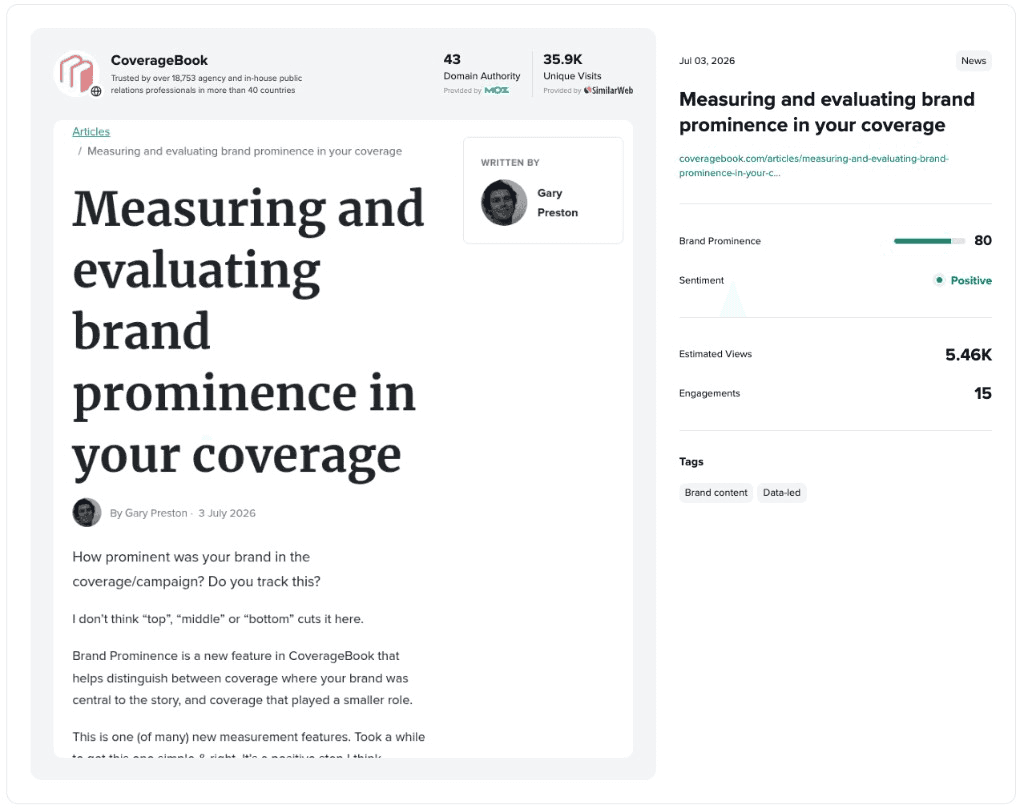
For online coverage, each selected piece gets a full-length screenshot, the article title, the outlet and per-piece data, sure.
But the real difference is that CoverageBook gives you a system to classify the quality of those pieces.
You can:
- See coverage type
- Record sentiment as positive, neutral or negative
- Add PR activity tags to show what drove the piece and use brand prominence to record how central your brand was to the story
These are not vague portfolio averages but they add context attached to the actual coverage you are discussing.
That matters when two pieces carry very different strategic value despite both being counted as a mention.
A short inclusion in a weekly roundup and a feature that puts your brand in the headline are both coverage. They are not the same result.
Brand Prominence helps distinguish between coverage where your brand was central to the story, and coverage that was just a passing mention. Our score is out of 100.
A higher score means your brand played a more prominent role in the coverage narrative.
The scoring works like this:
- 0 – No prominence – the brand does not appear in a meaningful way.
- 15-30 – Low prominence – The brand is mentioned, but plays a small role in the coverage.
- 35-50 – Moderate prominence – The brand has a noticeable role, but received limited space, detail or emphasis.
- 55-70 – Strong prominence – The brand is clearly visible or meaningfully described in the coverage.
- 75-100 – High prominence – The brand is a major part of the coverage and benefits from strong visibility, clear messaging, recommendation or action prompts.
The other key distinction that CoverageBook makes about coverage is around estimated views.
A big publisher’s traffic figure is useful context but it is not the same thing as the number of people who saw one article on that publisher’s site.
CoverageBook’s Estimated Views is designed to answer the second question.
It is a per-piece estimate of how many people could see a specific item of coverage over its lifetime.
The calculation uses site traffic as an input, while also accounting for factors including the placement of the article, the size and influence of the site and the social sharing activity around the piece.
You can explain what it represents, compare similar pieces on a consistent basis and avoid treating every article on a large publication as though it reached the full monthly audience of the site.
A curated dataset is more useful than a second spreadsheet
For a lot of PR teams, once they have their final list of coverage, they’ll often add everything to a spreadsheet tracker.
Somebody starts pasting in URLs. Somebody else hunts down screenshots, outlet information and metrics. Then someone has to turn that sheet into a presentation which is tidy enough to share with the client.
That is a lot of manual work for something that should be the enjoyable end of a successful campaign.
CoverageBook is built to replace that fragmented system.
Paste in the original URLs for online coverage and it collects the screenshots, publication information and available metrics. Add print, broadcast or other offline coverage using the coverage template, then keep the whole campaign in a consistent visual format.
Instead of treating the final list as a storage problem, CoverageBook turns it into a reusable intelligence asset.
There are three useful ways to use it alongside Cision.
1. CoverageBook can be the hand-off between monitoring and analysis
Use Cision to monitor the media landscape and identify coverage worth reviewing.
Once you have decided which pieces matter, put them in CoverageBook. That is where the selected coverage becomes an analysable dataset rather than a list of media mentions.
2. CoverageBook can be the home for coverage from every source
Cision should not be the place a team keeps track of coverage.
A campaign may include something a journalist sends directly, a niche publication found through manual research, an important social post or a print item that never appeared in the same monitoring stream. Cision won’t be able to find every single piece but CoverageBook gives you one consistent record for all of it.
The Coverage Vault also means that once a piece has been added, it can be searched, filtered and reused in future reports, pitches, award entries and stakeholder updates.
3. CoverageBook can be the version stakeholders actually see
Sure, the PR team may need the breadth and detail of Cision.
But most of the time it’s not what the client wants or needs to see.
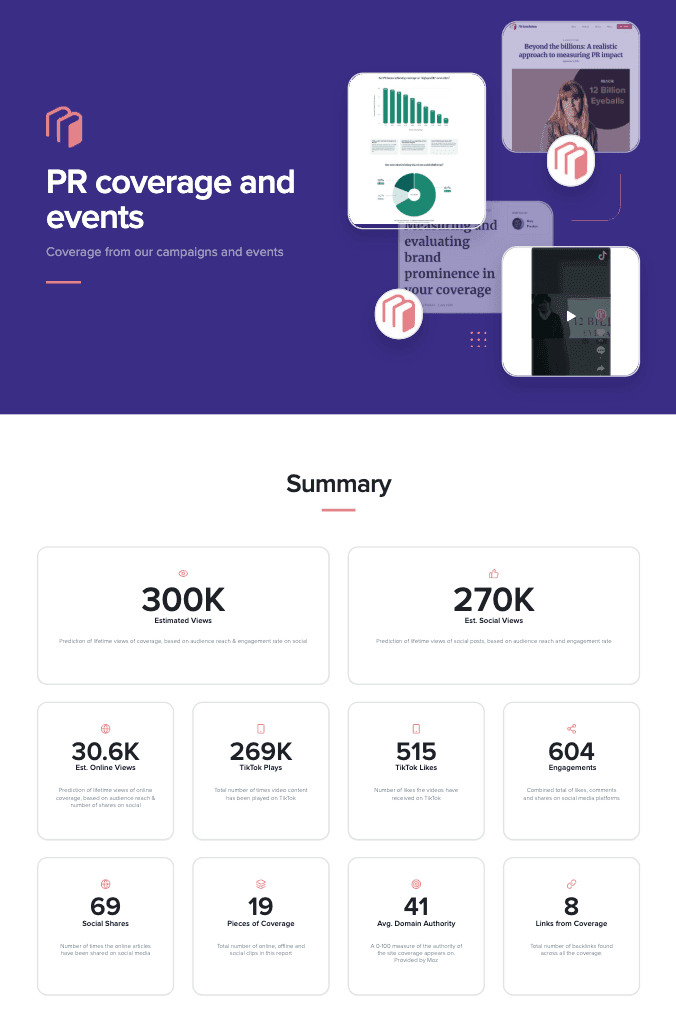
A CoverageBook report is a different presentation of the work for a different audience. It puts the actual articles, screenshots, metrics and campaign narrative at the centre rather than asking a stakeholder to interpret a monitoring interface.
Getting your Cision coverage into CoverageBook is a simple task
Although CoverageBook has no official native integration with Cision, and there is no automated sync between the products, it’s really simple for most teams to get their coverage into CoverageBook:
- Use Cision to monitor the coverage relevant to your campaign and review the original items you want to keep.
- Decide which online articles, social posts and offline items genuinely belong in the final dataset. Add any verified coverage found outside Cision at the same point.
- Paste the selected online URLs into CoverageBook. It gathers screenshots and the relevant available metrics, then creates a consistent coverage record for each item.
- Add the analysis tags that matter to you, set up the report layout and share the final report online, as a PDF or as a CSV export.
If you would rather capture coverage as you review it, the free CoverageBook Clipper Chrome extension gives you another simple option.
Bookmark the original article link as you browse, then copy the list of links into CoverageBook when you are ready to analyse the coverage.
You are already making an editorial decision about which pieces belong in the final story. CoverageBook gives that decision a proper home.
CoverageBook has a transparent monthly price when you want an analysis layer
Cision and CoverageBook do not solve the same-sized problem, so this is not an apples-to-apples pricing comparison.
Cision’s current request-pricing page presents tailored solutions for Journalist Outreach, Media Monitoring, Media Monitoring + Social and the full CisionOne Suite.
It does not display a standard price, contract length or usage allowance.
On the other hand, CoverageBook publishes its pricing openly.
Monthly plans start at $99 per month for 100 clips and up to five users.
Plans scale through Bronze, Silver and Gold (and Gold+) as clip volume and team size increase, with the largest listed plan at $899 per month for 2,000 clips and up to 150 users.
Every listed plan includes unlimited reports and projects.
There is no long-term contract, and you can pause, switch or cancel as needs change.
That makes CoverageBook easy to try as an extra analysis layer rather than a major platform replacement.
You can start a 30-day free trial without a credit card and decide whether it improves the last, most visible part of your workflow.
Cision and CoverageBook are not competing for the same job
Keep Cision for the work it is designed to do: media intelligence, monitoring, outreach and the wider PR workflow.
Use CoverageBook when the final job is curating a verified body of coverage, understanding it at a piece-by-piece level and communicating its value in a format people actually want to read.
They are not replacements. For the right team, they are two distinct layers of the same PR workflow.
If you are a Cision user who wants to add an analysis layer that makes coverage easier to measure, present and reuse, take a free 30-day trial of CoverageBook.